
Dicezzle
How to Play Dicezzle
Learn the rules of Dicezzle: place dice, merge three matching dice, create star dice, and clear space on the board.
Drag a tray die onto an empty cell, or tap the die and then the cell. Use the three tray dice in any order. There is no timer, so take a moment to look for your next match.
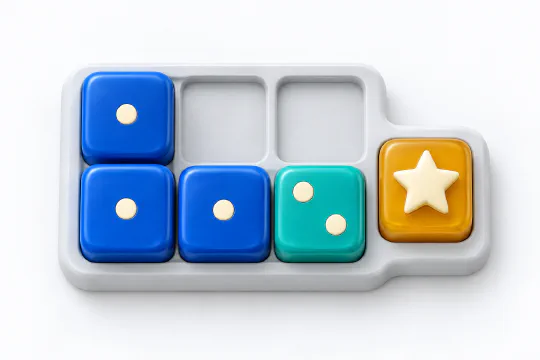
A little planning. More room to play.
Your next good move
Dicezzle is a free 5x5 dice merge puzzle. Start with a match, build a chain, and work your way to a Star.
01
Connect three
Three matching dice touching edge to edge become one die of the next value. Corners do not connect.
See the resultBack to the start
Three 1s become a 2. Two spaces open up.
The last matching die has just landed.
02
Set up a chain
Place the final 1 beside a pair of 2s. The new 2 joins them and merges again, all from one placement.
See the resultBack to the start
1 to 2, then 2 to 3. That is a chain of two merges.
The last matching die has just landed.
03
Make room with Stars
Sixes merge into a Star. Connect three Stars to remove the group and clear the 3x3 area around the merge target.
See the resultBack to the start
Nearby dice clear too. The 2 outside the area stays.
Three Stars have connected.
Match three or more of one value to reach the next. Star is the only gold tile.
Keep the board open
Four ideas for your next run
Look at all three tray dice
You can use the tray in any order. Choose the die that opens space or brings a matching pair closer together.
Choose where the upgrade lands
The new die stays where you made the placement. Put the last die beside the next value to prepare a chain.
Leave a route into your pairs
A pair is only useful if you can place a third die beside it. Avoid surrounding your matching dice with unrelated values.
Use the middle for Star Clears
A clear near the middle can reach all nine cells of its 3x3 area. At an edge, part of that area falls outside the board.
Try three practice puzzlesA pair, a chain, and a Star Clear. Which move would you choose?
What earns points?
Each placement earns 1 point. A merge earns points for the value you matched:
- Merge 1s
- 30
- Merge 2s
- 60
- Merge 3s
- 120
- Merge 4s
- 240
- Merge 5s
- 480
- Merge 6s
- 960
A Star Clear earns 2,000 points. Consecutive normal merges in one placement use multipliers of x1, x1.5, x2, x3, capped at the last multiplier.
Good to know
Why did my three dice not merge?
They must have the same value and connect through shared edges: up, down, left or right. Three dice touching only at their corners do not merge.
What happens when four or more dice match?
The whole connected group becomes one die of the next value. A larger group opens more cells, but does not create a different special block or add a group-size score bonus.
How do I move a tray die?
Drag it onto an empty board cell, or tap the die and then the cell. An invalid drop returns it to the tray without using the die or changing your score. Placed dice cannot be moved manually.
What do Stars and Clears count?
Stars counts how many Star dice you have created in this run, including ones later cleared. Clears counts how many Star Clear events you have triggered. Three or more sixes create one Star.
Can I continue after closing the page?
Yes. Classic and each Daily date save separately after valid moves in this browser. Return to the same mode and choose Continue. Restart replaces that run, not your personal records. Daily restarts use the same dice sequence. Clearing browser data removes saves; blocked or full storage can prevent saving. Sound starts off each page load; Restart keeps your current sound choice.
Can I play without a timer or account?
Yes. Classic has no countdown, login or purchases. Take your time between placements. The run ends when the board has no empty cell left after merges resolve.
How do I share a result?
At Game Over, choose Share Result or Copy Result. The text includes your score, best score, Stars, Star Clears, chain and rank. You choose whether and where to share it.
Play Daily Dice: the same dice sequence for everyone each UTC day. Classic and Daily progress are saved separately.
Play DicezzleDaily Dice: a fresh sequence, at your pace
Daily uses the same merge rules as Classic. Everyone playing the same UTC date and rules version receives the same tray sequence. You choose which tray die to place first and where it goes. There is no timer and no requirement to play every day.
When does the date change?
A new challenge opens at 00:00 UTC, which is 09:00 in Korea. The date shown in the game is the challenge date, not necessarily your local calendar date. An unfinished game keeps its original date when midnight passes. Choose Today when you are ready for the new sequence.
Continue or try again?
Continue restores the board, unused tray dice and future sequence. Retry starts that date’s sequence from the beginning; confirm the restart only when you want to replace its unfinished board. Your date-best score and completed record remain. Finishing the same date several times still counts as one completed date in the overview.
An older puzzle played today belongs to its original challenge date. The recent Daily progress summary covers today and the six preceding UTC challenge dates, not the days you opened the site. Its best score includes unfinished runs. A completed date means you reached Game Over at least once, not that you passed a score target.
Where are my records saved?
Progress is stored only in this browser on this site. Classic and each Daily date have separate saves. Another device, browser or site address does not share them; private browsing or blocked storage can prevent lasting saves. Clearing site data removes local progress. There is no account or cloud backup.
A useful way to replay
Try a different tray order or keep one finishing cell beside a matching pair. A replay is a chance to compare decisions, not a verified competition. When sharing scores, compare the same date and rules version and include the attempt number shown in your result.
Open your Daily records to continue a saved date, revisit a score or choose an older puzzle. For a short warm-up, try the three practice puzzles or read the tray-order example.